
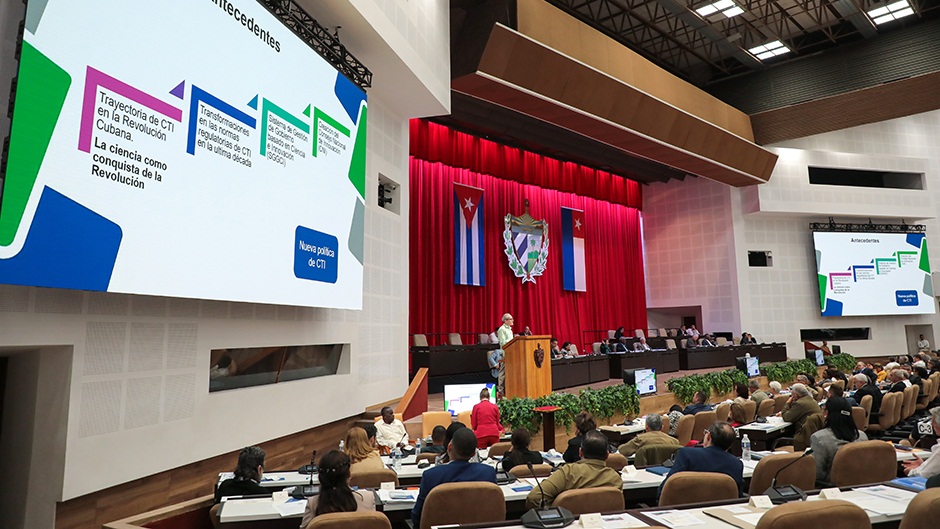
The National Assembly of People’s Power approved the General Law on Science, Technology, and Innovation this Thursday, as part of an effort to consolidate a system that recognizes both cutting-edge science and innovation based on practical experience.
During the presentation of the project to Parliament, Armando Rodríguez Batista, Minister of Science, Technology, and Environment, acknowledged that the law strengthens the formal connection between the national development strategy and sectoral and territorial policies, providing a legal framework for this articulation.
To draft the text, a temporary working group was established with representatives from institutions such as BioCubaFarma, the Ministry of Public Health, and the Ministry of Justice, among others. A comparative study was also conducted with countries from various regions.
The final text was enriched with 25 amendments following discussions with deputies from across the country. The new law comprises eight chapters and is presented alongside three complementary regulations: the Decree-Law of the Cuban Academy of Sciences, the Regulations of the Law, and a Decree of General Standards on Innovation and Rationalization.
Furthermore, it includes a specific article to establish an ethics commission on artificial intelligence.
According to Rodríguez Batista, the law aims to ensure that research results transcend the academic sphere and materialize in the economy, recognizing businesses as key players within the “knowledge economy.”
“It is essentially an incentivizing law; it opens doors, removes obstacles, and is inclusive,” he stated.
With its approval, Cuba intends to equip itself with a legal instrument that fosters a culture of innovation, prioritizes the practical application of knowledge, and guides scientific and technological efforts toward solving concrete problems and the nation’s sustainable development.
Source: http://www.cubadebate.cu/noticias/2025/12/18/parlamento-cubano-aprueba-ley-general-de-ciencia-tecnologia-e-innovacion/